Fantasiapelit - tuotehaku

Ruutunäkymän liikennevaloissa vihreä on heti saatavilla, punainen juuri nyt loppu varastosta, keltainen ei vielä ilmestynyt tai huutomerkin kera ei hyllyvalikoimaa, eli me tilaamme sitten, kun sinä olet tilannut meiltä. Saatavuusinfossa kerrotaan tarkemmin saatavuustiedoista.

Haun tulokset 1 - 24 / 381
sivukoko:
järjestys:

kuva on linkki tuotesivulle: All Bridges Burning: Red Revolt and White Guard in Finland, 1917-1918
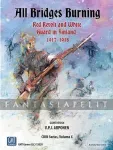
All Bridges Burning: Red Revolt and White Guard in Finland, 1917-1918

The year is 1917. Russia’s Tsar Nicholas II has abdicated and Russia slides toward an ever deepening internal crisis. On the western edge of the vast Russian Empire, the uncertainty in Russia is giving rise to a power vacuum in the semi-autonomous Grand Duchy of Finland. For many across the Finnish political spectrum, the turmoil in Russia looks like an opportunity to fulfill the dream of Finnish national independence. Yet the competing factions are unable to agree on a common political vision for the country. By January 1918, a bloody civil war will have broken out in Finland. All Bridges Burning recreates the political and military affairs of the Finnish civil war in a new COIN System volume for three players. The Reds seek to stage a working class revolt and then hold on to their gains, while the White Senate forces seek to reassert control. A third, non-violent Social Democratic faction fights for the survival of moderate leftism and political reform. All three factions must keep the national sentiment conciliatory enough for a post-conflict settlement and national independence. In addition, the non-player powers of Germany and Russia offer military assistance to the Senate and the Reds, respectively. Excessive foreign involvement, however, could quash the dream of Finnish independence and prompt a collective loss of all three player factions. Historical events, asymmetrical action menus, as well as extensive historical design notes familiarize the players with the historical period. A unique sequence of play for three factions poses players – whether veteran or new to the COIN Series – fresh challenges in selecting from the asymmetric commands and special activities. The Reds will find themselves needing to split time and resources between competing tasks of solidifying the Red revolt by creating working organs of civilian administration on the one hand, and fighting an increasingly desperate war against a far more powerful enemy on the other. The White Senate faction, in contrast, has a more traditional war to fight. The Senate will want to enhance their military performance by capabilities such as armored trains, cannons, as well as the Finnish, German-trained 27th Jaeger Battalion. Meanwhile the Social Democrats will be focused on building and maintaining underground networks of information, distributing news across the fronts, and advancing a stagnating political process while fending off retributions from the two warring factions. A simple but effective card-driven non-player system enables the game to be played solitaire as well as in a two-player mode. The structure of the sequence of play, the character of the commands and special activities in the game, the smaller number of players, and compact size combine to enable All Bridges Burning to play fast. The solitaire system has been designed to preserve that speed and fluidity of play. Game Components: * A 20" x 251/2" mounted game board * A deck of 47 Event cards * 17 Solitaire system cards * 88 wooden pieces - 20 red octagonal pieces, embossed - 20 white octagonal pieces, embossed - 6 blue octagonal pieces, embossed - 3 red discs - 2 blue discs - 6 gray cubes - 6 brown cubes - 3 red cubes - 3 white cubes - 2 red cylinders, embossed - 2 white cylinders, embossed - 2 blue cylinders, embossed - 1 gray cylinder, embossed - 6 tan and 6 green pawns (Note that some spare wooden pieces are included.) * A sheet of markers * The Rules of Play booklet * A Playbook booklet * Three 6-sided dice: 1 red, 1 white, 1 blue * 3 Faction player aid foldouts, each including the German Actions Flowchart * 1 Sequence of Play and Attack Procedure sheet * 1 Solitaire Play Aid Sheet Game Features: * Number of Players: 1 – 3 (includes full solitaire system) * Time scale: 6 to 9 months per campaign of 10 cards Designer: VPJ Arponen Developer: Örjan Ariander Series Creator: Volko Ruhnke

93.60 €
kuva on linkki tuotesivulle: Arctic Disaster Convoy PQ-17
Arctic Disaster Convoy PQ-17

In the hardest fought Arctic convoy battle of the war, Convoy PQ-17 was largely destroyed by German air and naval forces in July 1942. Arctic Disaster, by designer Mark Stille, simulates the journey of PQ-17 as it transits Arctic waters en route to northern Russia. The 33 merchant ships of the convoy were provided a large escort of anti-submarine ships to ward off U-boat attack, a close covering force of four heavy cruisers and three destroyers, and a distant covering force of battleships HMS Duke of York and USS Washington, carrier HMS Victorious, and another two cruisers and 14 destroyers. Nevertheless, in spite of this protection, only nine ships reached Russia. Arctic Disaster challenges the Allied player to use his assets wisely to run the convoy through and exact painful losses on the Germans. The Germans have assembled a large force of U-boats, torpedo-carrying aircraft and a heavy task force including battleship Tirpitz and heavy cruisers Admiral Scheer, Lutzow, and Hipper to crush the convoy. Arctic Disaster features individual counters for every ship and submarine, while the Luftwaffe is represented by 9-12 aircraft groups. The game system is built around the uncertainty of task force activation, replicating the weak command and control evident on both sides. Surface to air combat, surface combat, and anti-submarine combat is modeled with a clean system steering the players clear of an elaborate combat resolution process that permits quick play and multiple game iterations. Detection is also handled in a manner so as not to overwhelm other game functions. Special rules include convoy scatter and the reluctance of both sides to commit heavy ships in the area of play. 2 PlayersPlay Time: 720–900 Min

45.50 €
kuva on linkki tuotesivulle: Band of Brothers: Old Breed South Pacific
Band of Brothers: Old Breed South Pacific

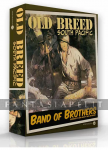
Band of Brothers: Old Breed South Pacific is a fast playing game of squad level combat in WWII. It covers the exploits of the U.S. First Marine Division in the battles for Guadalcanal. The rules are very simple (no combat charts are needed) with very few exceptions to remember and yet the game is meant to be all encompassing and will include infantry, tanks, and artillery. Based on years of research, the game system uses a unique suppression mechanic. There are no longer two unique states for a unit, but varying degrees of suppression. This allows suppression to accumulate from multiple fire sources and means that the unit will not take a morale check until it is asked to do something. You will never know for sure how your units will respond until they are needed. Although casualties can be caused by artillery and heavy weapons (which makes them prime battlefield targets), squads will never cause significant casualties shooting at range at dug in, first line troops. Their goal is to fire and maneuver. Sections of the enemy force must be pinned down and eliminated from up close. The system itself forces this realistic play. In a similar fashion, the system rewards you for spreading your troops out and other realistic game play. Another unique feature of the game is its use of Proficiency and Casualty ratings to differentiate squads in areas besides just morale. Old Breed South Pacific is a STAND ALONE GAME, but is also part of a growing series of tactical games. Band of Brothers: Screaming Eagles is the first in the series and follows the U.S. 101st Airborne Division. Band of Brothers: Ghost Panzer is the second in the series and follows the German 11th Panzer Division. Band of Brothers: Texas Arrows is a dependant expansion that follows the U.S. 36th Infantry Division. 2 PlayersPlay Time: 90 MinAge: 12+

103.40 €
kuva on linkki tuotesivulle: Birth of a Legend
Birth of a Legend

Simulation of the Seven Days' Battles which started Robert E. Lee on the road to glory. The setting is the Union’s Peninsula Campaign in the spring of 1862. McClellan has formed and trained a large army, transported it by sea in an outflanking maneuver, marched it to the gates of the Confederate capital, and is poised to capture the city and probably bring an end to the rebellion. On the Confederate side Lee has taken over the Army after Johnston was wounded. Unlike Johnston, who was content to fight a largely defensive campaign, Lee gathered every unit he could get his hands on and launched his own offensive. The Union had placed its army in an awkward position, with one corps north of Chickahominy River and the rest south of it. Lee’s plan, and the position of the units when the game starts, was to crush the Union Corps and then drive the rest of McClellan’s army from the capital, destroying as much of it as he possible could. With that accomplished he would have a free hand to turn north. The system is a simplified version of two games, the last area-impulse Avalon Hill published, Breakout: Normandy, and MMP's Monty's Gamble: Market Garden. The game features leaders who are rated for initiative and combat effectiveness. Another mechanism in the game is the “advantage” marker which can be traded to the opponent to do things like rally, conduct a combined assault, declare a heroic defense that turns a success into a stalemate, or receive additional replacements. The victory conditions are based on territorial control. For the Union that was Richmond. For the Confederacy that was the Union supply heads – White House Landing and Harrison’s Landing – and Malvern Hill. A key decision for the Union player is when to shift his supply train from White House Landing to the more secure location at Harrison’s Landing. The unit scale is divisional including artillery and cavalry. There is the campaign game, and a few optional rules. Playing time should be under three hours between experienced players. 2 PlayersPlay Time: 180 Min

39.80 €
kuva on linkki tuotesivulle: Clash of Carriers
Clash of Carriers

The Battle of the Philippine Sea featured a total of 24 carriers on both sides. It was simply the largest carrier battle of all time. Clash of Carriers portrays this epic battle. The historical result saw the Japanese carrier force shattered, never to recover for the rest of the war. While this showdown is almost always treated as a one-sided affair, in this game players will have every opportunity to better the historical outcome or maybe even even reverse history. The Japanese player can use the superior range of his carrier and land-based aircraft in coordinated waves to hit the US Navy while his fleet maneuvers out of US aircraft range. Historically, despite poor aircraft coordination, many Japanese aircraft broke through the US fighter screen to attack US carriers. What could better coordination accomplish? The American player can opt for an offensive strategy with a number of task groups to try and inflict even more massive losses on the Japanese naval force instead of settling for defeating the Japanese air strikes. US submarines inflicted losses and tracked Japanese fleet movements -- can they do so again, or will Japanese counter-measures foil historical results? Each game turn is roughly six hours with three day turns and one night turn per calendar day. Each sea hex is approximately 25 nautical miles across. Each naval unit represents one ship (for battleships, cruisers, and carriers) or four ships (destroyers). Aircraft units represent between six and 20 aircraft. What-if scenarios add optional surface and air forces. 1–4 PlayersPlay Time: 60–120 MinAge: 12+

51.20 €
kuva on linkki tuotesivulle: Clash of Sovereigns: The War of the Austrian Succession, 1740-48
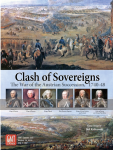
Clash of Sovereigns: The War of the Austrian Succession, 1740-48

December 1740: Young King Frederick II leads the army of upstart Prussia in a surprise invasion of Austrian Silesia. He hopes for an easy conquest of the rich province at a time when the Austrian Empire appears vulnerable following the death of Charles VI, King of Austria and Holy Roman Emperor. But despite internal opposition to the ‘Pragmatic Sanction’ that allowed a woman to inherit the throne, Austria’s new Queen, Maria Theresa, is cowed neither by Frederick, nor by France’s scheme to place a Bavarian puppet candidate on the throne of the Holy Roman Empire, nor by Spanish designs on Austria’s holdings in Italy. Amid these conflicting dynastic ambitions, Frederick’s local territorial coup proves to be only the opening act in a major European war that none of the great powers had anticipated - but all wished to profit from. It would ultimately span eight years and half the globe. Clash of Sovereigns (COS), GMT’s 2-4 player card-driven game of the War of the Austrian Succession, has been 9 years in the making. It is a free-wheeling, faster-playing, stream-lined “nephew” of the widely-regarded Clash of Monarchs (COM). Features: * A 12-hour campaign game and three shorter scenarios covering 2-3 years apiece that can be played to completion in as little as three hours! * 2-4 players. * The French, Prussians/Spanish (“Pr/Span”), Austrians, and British/ Piedmontese (“Br/Pied”) each have their own separate card decks divided into Early, Middle, and Late war periods * Half a dozen minor powers add their own blood and diplomatic wrinkles to the tableau – and can sometimes reshape it utterly by switching sides. * Leaders are rated for Initiative, Offense and Defense modifiers, and Action Points. * Distinctive national tactics and troop quality factors are ‘captured’ by Army Battle Ratings (which evolve over time) and event and Battle Tactics cards. * A simple, but significant, naval sub-game simulates naval operations in the Mediterranean and Atlantic, including the annual Bourbon Treasure Fleet’s risky voyage home. * Colonial conflicts in Canada and India are simulated by event cards * Design-for-Effect economic factors are “baked into” the event and reinforcement cards and can therefore be resolved in only a small fraction of the time required by COM’s more complex economic model. The Bourbon (French, Spanish, Prussian) and Pragmatic (Austrian, British) alliances battle across central Europe from Paris to Konigsberg and Naples to London. Each year is divided into five ‘seasons’ (Late Winter, Spring, Summer, Fall, and Early Winter). Play moves quickly since major campaigning is restricted to the Summer and Fall, and each power will typically activate only 1-3 forces per season. Certain event cards allow limited campaigning in the Early and Late Winter seasons as well. Each card has a Campaign Point (CP) value, which may be expended to activate Leaders and the armies they command, to perform Administrative Marches, and to conduct raids with irregular Croat/Hussar light troops (Austrian player only). Each leader has an Activation Point (AP) rating, which allows him to move, fight battles, and conduct sieges. This system produces historically valid outcomes and a rich narrative while keeping the pace of play brisk. COS features asymmetrical armies with distinctive national characteristics and capabilities that have banded together in alliances that often struggle with conflicting goals. Both the Bourbons and Pragmatics will benefit – or suffer from – interactions among the various nations in their respective alliances. The French player controls the largest, best-led army on the continent but is constrained by its limited logistical reach, King Louis XV’s quirks and maladies, court intrigue, and periodic pressure from his Spanish ally. The French will welcome the Pr/Span player’s powerful Prussian army lancing into the Austrian heartland in early/mid game but chafe under Spanish demands for cooperation and campaigning in Italy – the only place the Spanish can hope to gain the VPs necessary for victory. The Pr/Span player is both blessed and cursed. In Prussia, he has a powerful army, Frederick’s excellent generalship, and clear objectives. Yet the politically naive Frederick can be “played” into neutrality - or out of the war completely – by wily Austrian diplomacy. Spain itself has an excellent but undersized army that so depends upon French support that the French player decides when Spanish forces will be activated for the Pr/Span player to campaign with! In order to win, the Pr/Span player needs either a Decisive Prussian victory (rare) or for both Prussia and Spain to achieve lesser levels of victory. Thus, the Prussian “frere” of 1740-1745 may become a great nuisance in 1745-1748! The Pragmatic allies must weather the early war storms of 1740-1742, get their feet under them, and somehow gain traction to push back their powerful French and Prussian foes. They are equal to the task. The Austrian army has solid leaders and its unique Croat/Hussar light troops, which devastated enemy supply lines throughout the war, leaving French and Prussian commanders bewildered and their armies starving. Maria Theresa’s army can prevail against the French and Prussians - if it’s robustly financed to achieve maximum strength. For this, the Austrian player must rely upon the good will and immense financial resources of the Br/Pied player. The Br/Pied player has the most subtle, difficult – and most important – role in the game. He has a high-quality British/allied army, but it is small, led by indifferent leaders, and can generally be augmented only by low-quality Dutch troops since Austria will have its hands full fighting elsewhere. Yet this mediocre, polyglot army is often the primary protector of the VP-rich Austrian Netherlands against the mighty French Marshal De Saxe! The British player must also selflessly prop up his allies by playing subsidy (reinforcement) cards, which are essential for Austria’s survival and ability to launch counteroffensives in the mid and late war periods. But the British player has a powerful fleet and, if he (literally) plays his cards right, can use it to cut off France from its overseas resources, starving it of reinforcements in the critical late war years. The British player also controls the Kingdom of Piedmont and can win the game only if it too achieves some level of victory. Piedmont occupies a central position in Northern Italy that sits astride the routes running to the VP-rich areas in Naples and southern France and is itself the chief region where the Pr/Span player can harvest VPs. The Austrians can accomplish little in Italy without the Pieds' help, and vice versa – though they both covet the same Victory Point objectives! So if the Austrian player wants all those subsidy cards played, he may have to help Piedmont achieve its VP objectives, send more Austrian troops to defend the Netherlands, and share late war opportunities to grab VP spaces on the French-Germany border with the British. COS’s replay value is high because the multiplicity of belligerents and theaters of operation ensure that the game will never play the same way twice. Vienna may fall to the Prussians or French; Paris and Naples may see Austrian white uniforms in their streets; and London may be beset by Bonnie Prince Charlie – or invading French troops. Will the French get Bavarian Charles VII onto the throne of the Holy Roman Empire? Will Marshal Traun and Austrian Croats take it back? Will Louis XV and George II clash in Flanders? And will anyone be able to stop De Saxe? -- Find out! Components: * One 22" x 34" mapsheet * 150 Strategy cards * 10 Day of Battle Cards * 350 10/16-inch counters * 120 1/2-inch markers * Four 8-1/2" x 11" Player Aid cards * Four 5-1/2" x 8-1/2" Power Mats * One 24-page Rule Book * One 20-page Play Book * Two six-sided dice Designer: Bob Kalinowksi Developer: Kevin Boylan
89.70 €
kuva on linkki tuotesivulle: Commands & Colors Medieval
Commands & Colors Medieval

Commands & Colors: Medieval is based on the highly successful Commands & Colors game system and by design is not overly complex. The Medieval game introduces many new game concepts to the Commands & Colors system, which add historical depth and flavor. Some of the new concepts are: * Superior armor and status when battling * Cavalry units increase to 4 blocks * Heavy infantry battle dice are reduced from 5 dice down to 4 * Light Bow Cavalry units can employ the Parthian Shot when they evade Still, some Commands & Colors game mechanics remain familiar to players of other games in the system, like the deck of Medieval Command cards that drive movement while creating a “fog of war,” and the battle dice that will resolve combat quickly and efficiently. The stylized battlefield scenario maps emphasize the important terrain features and highlight the historical deployment of forces in scale with the game system. The scale of the game is flexible, and varies from battle to battle. For some scenarios, a unit may represent a Chiliarchy of soldiers, while in other scenarios a unit may represent just a few brave warriors. The battlefield tactics, however, that you will need to execute to gain victory conform remarkably well to the strengths and limitations of the various medieval unit types, their weapons, the terrain, and history. The medieval battles showcased in the scenario book focus on the historical confrontations between the Byzantine Empire and Sassanid Persians (530 to 627 AD) with a slight detour to battle the Moors and their rebel allies (645 - 648 AD). The Byzantine Empire during this period of medieval history was one of constant transition and reorganization. Its army tended to mirror its eastern adversaries by deploying an increasing number of armored cavalry formations (Cataphracts) and more missile troops. Yet, it was how the Byzantines adapted their battlefield tactics in relation to the enemy it faced that is perhaps the chief reason for the longevity of their Empire. Tentative Scenarios * Dara - 530 AD * Utus River - 447 AD * Catalaunian Fields Roman Left - 451 AD * Catalaunian Fields Roman Right - 451 AD * First Thannuris - 528 AD * Satala - 53 AD * Callinicum Phase 1 - 531 AD * Callinicum Phase 2 - 531 AD * Ad Decimum Phase 1 - 531 AD * Ad Decimum Phase 2 - 531 AD * Ad Decimum Final Phase - 531 AD * Tricamarum - 533 AD * Lazic War: Petra Mountains - 548 AD * Lazic War: Phasis River - 549 AD * Lazic War: River Hippis - 550 AD * Lazic War: Onoguris - 555 AD * Solachon: Main Battle - 586 AD * Solachon: Kardarigan's Stand - 586 AD * And More... Although the Byzantine army fought on other frontiers, against a multitude of opponents, Visigoths, Vandals, Ostrogoths, Franks, Alemanni, those conflicts are beyond the scope and space of this one package. Additional expansion modules that address those battles will be forthcoming. Components: * 1 Medieval Core Rule Book and 14 medieval battle scenarios * 1 Oversize Mounted Battlefield game board (11 hexes deep by 13 hexes wide) * 4 Sheets containing 56 double-sided Terrain Tiles, Victory Banners & markers * 60 Medieval Command cards (new card deck) * 8 Battle dice * 2 Reference Cards * 5 Block and Dice Label sheets * 320 Plus Blocks (blocks are similar in size to C&C Ancients) Game Design: Richard Borg

117.00 €
kuva on linkki tuotesivulle: Conquest and Consequence
Conquest and Consequence

Conquest and Consequence brings the Triumph and Tragedy system to the Pacific/East Asia theater during the same 1936-1945 time period. Like T&T, it is designed for 3 players, maintaining the 3-sided dynamic that adds so much variety and intrigue to the system. Militarist Japan, the first Asian power to modernize, seeks to replace the European colonial empires in East Asia with a true “all-Asian” empire, with itself as the natural leader. The Communist Soviet faction comprises the Siberian USSR and the Red Chinese revolutionaries. The Capitalist USA faction consists of the United States, the British Empire, and the struggling regime of Nationalist China. The game begins in 1936 with the Militarists in control of Japan and expansion on the agenda. Its [war] industry is well developed, but it is weak in population and particularly resources. Its battle-hardened army has easily overrun resource-rich Manchuria, and a weak China awaits. Japan (like Germany in T&T) has the early initiative due to its well-prepared military. Will it: * Move south into China? * Take the “Northern Road” into resource-rich east Siberia (as favored by the army)? * Pursue the “Southern Road” to the oil-rich Dutch East Indies advocated by its navy? * Or bide its time, seeking a better position via diplomatic arrangements with neutrals including independent Chinese warlord states? Japanese aggression in China will likely irritate the sleeping giant that is the USA, but it is far away across the wide Pacific, and Japan has special naval abilities that allow it to compete at sea. The Red Chinese have just completed their Long March and re-established their base in inland Shaansi, far from areas of Japanese (or Capitalist) interest. The Red Chinese are very weak militarily but have a secret weapon: Partisans. These are non-military “political” organizations (represented on-map with cardboard counters) that are difficult to eradicate, multiply if ignored, and can be converted into military units when desired (this being ill-advised without sufficient concentration). The Soviet Union, also acutely aware of Japanese expansionism, is desperately fortifying eastern Siberia, which is otherwise thinly defended. Nationalist China is aware of the Japanese threat but must also deal with the internal Communist threat. The United States is disarmed, disinterested, and distracted by the Great Depression. The British Empire is woefully under-defended and overconfident. The USA alliance must build up its economy while somehow improving the military capabilities of the British Empire, Nationalist China, and itself. The game combines the Pacific naval war and the land war in Asia (including the Chinese Civil War), both equally weighing upon victory. The naval war is dramatic, featuring short, decisive battles and expanded roles for airpower and island bases. In the tradition of Triumph and Tragedy, the 3-sided aspect features negotiation, diplomacy, and subterfuge within a multitude of strategic possibilities. Like T&T, the game allows players freedom to diverge from the inclinations and policies of the historical actors and plays in 4-6 hours of constant tension and involvement. COMPONENTS: * 22”x 34” Mounted mapboard * 228 wooden blocks * 2 label sheets (sticky labels) * 2 5/8” counter sheets * 55 Action cards * 55 Investment cards * 28-page Rulebook * 32-page Playbook * 3 Player Aid cards (2-sided cardstock) * 1 pad of Game Record sheets * 4 6-sided dice DESIGNER: Craig Besinque DEVELOPER: Simon McDonald ART: Charlie Kibler and Carlos Olivares PRODUCTION COORDINATOR: Tony Curtis PRODUCERS: Andy Lewis, Rodger MacGowan, Gene Billingsley, Mark Simonitch, Tony Curtis

155.00 €
kuva on linkki tuotesivulle: Cuba Libre
Cuba Libre

In December 1956, paroled rebel Fidel Castro returned to Cuba to launch his revolution with virtually no political base and—after a disastrous initial encounter with government forces—a total of just 12 men. Two years later, through masterful propaganda and factional maneuver, Castro, his brother Raúl, and iconic revolutionary Che Guevara had united disparate guerrillas and exploited Cubans’ deep opposition to their dictator Fulgencio Batista y Zaldívar. Castro’s takeover of the country became a model for Leftist insurgency. Castro’s Insurgency Following up on GMT Games’ Andean Abyss, the COIN Series next volume, Cuba Libre, takes 1 to 4 players into the Cuban Revolution. Castro’s Marxist “26 July Movement” must expand from its bases in the Sierra Maestra mountains to fight its way to Havana. Meanwhile, anti-communist student groups, urban guerrillas, and ex-patriots try to de-stabilize the Batista regime from inside and out, while trying not to pave the way for a new dictatorship under Castro. Batista’s Government must maintain steam to counter the twin insurgency, while managing two benefactors: its fragile US Alliance and its corrupting Syndicate skim. And in the midst of the turmoil, Meyer Lansky and his Syndicate bosses will jockey to keep their Cuban gangster paradise alive. COIN Series, Volume II Cuba Libre will be easy to learn for Andean Abyss players—both volumes share the same innovative COIN system. Like Volume I, Cuba Libre is equally playable solitaire or by multiple players up to 4—and with a shorter time to completion than Andean Abyss. But Cuba Libre’s situation and strategic challenges will be new. A deck of 48 fresh events brings 1950s Cuba to life and includes... • The Twelve: The first wave’s escape to the Sierra Maestra—inspirational legend or harbinger of defeat? • El Che and Raúl: Brilliant in the field, or bungling hostage-takers? • Operation Fisherman: Can the Marxists pull off a second invasion? • General Strike: Urban disruption or rebel embarrassment? • Radio Rebelde: Are the masses tuning in, or just the Army direction finders? • Pact of Caracas: Can the rebels unite? • Armored Cars: Mobile striking power, but in whose hands? • Rolando Masferrer: Brutal pro-government tactics—will they help or hurt? • Fat Butcher: Can the Mob’s enforcer protect its casinos? • Sinatra: Frankie’s Havana show a boom or bust, and who collects? ...and much more. New twists match the COIN system to the situation in 1950s Cuba: • It’s the insurgents who build lasting capabilities, while the Government is limited to fleeting bursts of momentum. • The Syndicate’s bases are Casinos—expensive to build, but so important to Cuba no army will destroy them. • Syndicate special activities include calling in the “muscle” of Government troops and police to protect mob assets. • Stacks of Syndicate cash awaiting launder can fall in anyone’s hands—even the corrupt Government’s. • The Government has its own terror tactic—reprisals—and can skim a portion of Syndicate profits. • The eroding US Alliance with Batista overshadows all Government actions, not just through aid levels but also through the day-to-day ability of troops and police to operate. • Even if Batista flees, the struggle may not end—the counterrevolutionary government may even become stronger! Multiplayer, 2-Player, Solitaire Cuba Libre provides up to 4 players with contrasting roles and overlapping victory conditions for rich diplomatic interaction. For 2- or 3-player games, players can represent alliances of factions, or the game system can control non-player factions. Or a single player as the Cuban Revolutionaries can attempt to topple Batista and seize power for themselves. The non-player sides will fight one another as well as the players, but too much power in the hands of any one of them will mean player defeat. COIN Series Volume II Cuba Libre like its predecessor Andean Abyss presents a game system on modern insurgency readily adaptable to other conflicts, particularly those featuring the interaction of many sides (thus our COunterINsurgency series). A rich and under-represented history of 20th-Century guerrilla warfare beckons. Volume III is A Distant Plain—Insurgency in Afghanistan, and Volume IV is Fire in the Lake—Insurgency in Vietnam." Components: * A 17”x22” mounted game board * A deck of 52 cards * 79 dark and light blue, red, green, and yellow wooden forces pieces, some embossed. * 8 embossed cylinders * One sheet of markers * One background play book * One rule book * A Sequence of Play sheet * 4 Faction player aid foldouts * 2 Non-Player Aid foldouts * 3 6-sided dice Designers: Volko Ruhnke & Jeff Grossman

93.60 €
kuva on linkki tuotesivulle: Death Valley: Battles for the Shenandoah Expansion
Death Valley: Battles for the Shenandoah Expansion

Battles for the Shenandoah: A Death Valley Expansion is a Great Battles of the American Civil War (GBACW) series expansion for Death Valley, published by GMT Games. Four full battles are included. McDowell, May 8, 1862 McDowell is considered the first battle of Stonewall Jackson’s 1862 Valley Campaign. After his loss at Kernstown, Confederate General Thomas J. “Stonewall” Jackson retreated up the Shenandoah Valley, finally stopping at Swift Run Gap to rebuild his army. By May of 1862, the threat from the north had diminished when two of the three Union divisions under General Nathaniel Banks were redeployed to support the Union advance on Richmond. However, there was another Union force, led by Brigadier General Robert H. Milroy, approaching the critical town of Staunton from the west. Jackson planned to drive the Union from the Shenandoah Valley and help relieve the pressure on Richmond by consolidating several scattered Confederate forces and defeating the two Union armies in detail. The first step was to move his army to join Brigadier General Edward “Alleghany” Johnson’s Army of the Northwest and defeat Milroy. The Confederate armies were consolidated on May 6 and begun advancing on Milroy’s Union force. Milroy retreated before them until May 8th, when he was reinforced with a brigade under Brigadier General Robert C. Schenck. That afternoon, the aggressive Milroy turned to attack the Confederate forces arriving on the heights overlooking the hamlet of McDowell. 2nd Winchester, June 13, 14, and 15, 1863 2nd Winchester is the battle that cleared the way for Robert E. Lee’s Gettysburg Campaign. In June of 1863, General Robert E. Lee finalized his plans for his second invasion of the north. The supply line was to be routed through the lower Shenandoah Valley, then primarily occupied by a Union garrison at Winchester with smaller garrisons at Berryville and Martinsburg. Lee assigned the task of clearing the Valley to Lieutenant General Richard S. Ewell, now in command of II Corps after Jackson’s death at Chancellorsville in May. The Union garrison at Winchester consisted of the 8500 men of the 2nd Division, VIII Corps, commanded by Major General Robert H. Milroy. Milroy had made extensive improvements to the fortifications around Winchester and was confident that he could hold the position against anything the Confederates could throw at him. He was so confident that he ignored orders to abandon Winchester. On June 13, he discovered that Ewell had arrived. Piedmont, June 5, 1864 Piedmont was the first Union victory in the Valley since Kernstown in 1862. The Confederate loss compelled Lee to send Lieutenant General Jubal Early’s II Corps to retake the Shenandoah Valley, effectively ending any hope Lee may have had for offensive operations around Richmond. After New Market, Union Major General Franz Sigel was replaced with the more aggressive Major General David Hunter, who made another move up the Valley with a larger and better organized army of 12,000 men. Hunter’s move caught the Confederates by surprise. Initially, the only opposition was a brigade of Confederate cavalry led by Brigadier General John D. Imboden. Every able-bodied man in the area was called to the Confederate colors, including miners and militia reservists. Two brigades of infantry under Brigadier General William E. “Grumble” Jones and a cavalry brigade led by Brigadier General John C. Vaughn were rushed by rail from the Trans-Allegheny Department. The combined Confederate force, commanded by Grumble Jones, numbered about 5000 men. On June 5th, the Confederate cavalry skirmished with the leading Union cavalry, delaying the Union advance long enough so that Grumble Jones could deploy his newly arrived troops and begin fortifying a new position near the hamlet of Piedmont. Hunter’s infantry arrived at this new line around noon. Cool Spring, July 18, 1864 Cool Spring is a battle from Jubal Early’s 1864 Valley Campaign. During his retreat from the drive on Washington, Early moved into the Shenandoah Valley through Snicker’s Gap and crossed the Shenandoah River at Castleman’s Ferry. His Union pursuers, formations from VI Corps, XIX Corps, and the Army of West Virginia led by Major General Horatio G. Wright, were close behind. Brevet Major General George Crook, at the head of Wright’s column, was ordered to “cross if practicable and attack” with his Army of West Virginia. When a cavalry probe of Castleman’s Ferry was easily repulsed, it was decided to move downstream, cross the Shenandoah River at Island Ford, and then turn south to catch the Confederate defenders of Castleman’s Ferry in flank. Crook’s 1st Division, led by Colonel Joseph Thoburn, began the crossing in the middle of the afternoon after waiting for the lead division of VI Corps to arrive in support. The fords appeared to be lightly defended by the Confederates, but a captured skirmisher revealed that the divisions of Brigadier General Gabriel Wharton and Major General Robert Rodes were nearby. The lateness of the Union move surprised Early, but he had issued orders the night before to contest any Union crossing, and Wharton and Rodes were both moving within the hour. The Great Battles of the American Civil War Series: This series is one of the hobby’s longest-lived design concepts, springing from the legendary regimental level Gettysburg game – Terrible Swift Sword (SPI) – designed by Richard Berg in 1976. Under GMT Games, the rules system has remained stable but has shown remarkable flexibility to allow each game to smoothly incorporate additional rules to reflect the historical battles. The series relies on interactive chit-pull mechanics to simulate the oftentimes-chaotic nature of the 19th Century battlefield at the regimental level. The Game: Battles for the Shenandoah: A Death Valley Expansion contains four battle games with multiple scenarios. Experienced players will be able to play many of the scenarios in one sitting. The game reflects the development of the cavalry and the changes in infantry and artillery organization and tactics from 1862 through 1864. COMPONENTS: * 560 counters * Two 17” x 22” double-sided maps * One 11” x 17” double-sided map * One 8 1/2” x 11” map * One Battle booklet * Eight Activation and Turn Record charts * One Terrain Effects Chart * One Range Effects Chart The remaining components necessary for play can be found in GMT’s Death Valley: Battles for the Shenandoah. These include the Player Aid Cards, the 2nd Disorder Chart, the game markers, four maps, and a ten-sided die. The GBACW Series Rules can be found on the GMT website. TIME SCALE: Each Turn = 1 Hour MAP SCALE: 145 Yards Per Hex with 25-Foot or 50-Foot Elevations UNIT SCALE: 50 Men or 1 Cannon per Strength Point

45.50 €
kuva on linkki tuotesivulle: Down in Flames Squadron Pack 2: Bombers
Down in Flames Squadron Pack 2: Bombers

Following on the heels of the first Squadron Pack for the Down in Flames series of WWII air combat card games comes Squadron Pack 2: Bombers. While the first pack contained new fighters, this one adds more Light Bombers and Formation aircraft to the system. The pack will include such famous aircraft as the B-25H (complete with 75mm gun) and the Il-2m3 Shturmovik. But there will be lesser-known planes as well, like the German Hs-129B-1/R2 (a sort of WWII version of today's A-10) and the Italian CANT Z.501 Gabbiano flying boat. All the cards will be printed in the eight-per-sheet (cut 'em out yourself) style of C3i-DiF module inserts that you've enjoyed over the years. One of the difficulties in creating a pack of bombers and patrol planes is that up until now these aircraft types have only been used in the context of a Down in Flames campaign. The rules included in the pack provide three ways around this problem. First, there are guidelines for adding Formation aircraft to basic game dogfights. Second, the pack includes a number of stand-alone generic missions into which players can simply "plug in" appropriate aircraft. Finally, we have included rules (courtesy of Roger Horky) that allow Formation aircraft to engage in a form of dogfighting (called Gunnery Duels in the game) with other Formation planes. So if you've ever wanted to fly a Short Stirling against an FW-200 Condor, now's your chance. Squadron Pack 2's rules also contain reprints of some of the rules from Corsairs and Hellcats for the benefit of those players who don't own that game (you know who you are). In addition, there are rules for two new ground attack weapons: the German Hs 293 radio-controlled air to surface missile and Fritz X radio-controlled glide bomb. Like the first pack, Squadron Pack 2: Bombers will contain 64 new aircraft cards printed 8 to a sheet in the same enhanced graphic style as Squadron Pack 1. The pack will also include a short (4-8 page) rulebook and an 11x17 wrap around cover decorated with Rodger MacGowan's gorgeous artwork. The inside of the cover sheet will form a play mat for use during Gunnery Duels. Developers: Mike Lemick and Rodger B. MacGowan

24.00 €
kuva on linkki tuotesivulle: Drop Zone: Southern France
Drop Zone: Southern France

Drop Zone: Southern France is a fast-playing (about 2 hours), company-level game of the Allied airborne assault (code-named Operation RUGBY) that spearheaded Operation DRAGOON, the Invasion of Southern France—the Second D-Day, August 15th, 1944. The game can be played face-to-face, by 2, 3, or 4 players or solitaire (as the Allies). Early on the morning of D-Day, the allied First Airborne Task Force (1st ABTF) parachuted a dozen miles behind the Riviera landing beaches to seize key towns and road junctions, to prevent the German occupation forces from counter-attacking the amphibious landing, and to facilitate the advance of Allied forces. The 4:00 AM parachute drop was badly scattered due to an unexpected dense fog bank that blanketed the battlefield. Drop Zone: Southern France covers the first two days of this airborne operation in six tense turns, when the American and British paratroopers and glider-men fought surrounded and alone, supported only by French resistance bands. The game board is a hex map of the Argens and Naturby River valleys and surrounding areas in Provence, Southern France, covering the area of operations. Each hex measures about 500 meters across. The key towns, villages, roads, rivers, and bridges that were fought over are indicated. The counters portray companies and company-sized units of allied paratroopers and glidermen, French resistance bands, German Infantry, and a few small armor units on both sides. Assets depict fire support units (artillery, heavy mortars, and anti-tank guns) as well as key capabilities (such as reconnaissance and seizing initiative). Drop Zone: Southern France shines in its depiction of the fog of war (both literal and figurative)--unit type and strength is concealed until revealed in combat. On the first day, Allied parachute companies begin scattered across the board with minimal strength. German reinforcements arrive in a random fashion, often surprising and disrupting the plans of the opponent as well as the controlling player. The correlation of forces ebbs and flows as the Allies gradually build up their parachute companies and gliders deliver reinforcements and heavy weapons. Meanwhile, German reinforcements steadily increase in quantity and quality. The chit pull activation system adds another level of uncertainty. By D+1, the second day, both sides have gained in strength and acquire more powerful assets, leading to larger, bloodier battles as time runs out to achieve victory. It often comes down to the final roll of the dice. 2 PlayersPlay Time: 120 MinAge: 14+

99.80 €
kuva on linkki tuotesivulle: Field Commander: Rommel Deluxe
Field Commander: Rommel Deluxe

Deluxe Edition: This edition of Rommel has the same content as our original game. The Deluxe version features mounted maps, extra thick counters, and a new taller box. Rommel was designed by Dan Verssen and was the first game in our "Field Commander" solitaire series of historical strategy board games. You get to take command of General Erwin Rommel's forces in 3 exciting WWII campaigns: France 1940, North Africa 1941, and D-Day 1944. An easy to use game system manages the Allied movement, combat, and reinforcements. The counters are beautifully printed and die cut with full color on both sides. The game box is 9" x 12" x 1.5". Each of the 3 MOUNTED Campaign Map pages are 11" x 17" to provide both a large playing area, and fit nicely on an average table. As your units win battles, their stats will increase. Each campaign comes with a list of historical options. You can select any of these options to modify the campaign, and its difficulty level. This allows each campaign to be replayed many times and never be the same twice. The game comes with "Career" rules that allow you to link the campaigns. The outcome of one campaign affects your start-up conditions for the next campaign. Game Time: Each campaign can be played in 2 hours. Complexity: Low to Moderate Players: 1 Ages: 12 and up Components: * 3 Full Color MOUNTED Campaign Maps (11" x 17") * 176 Full Color EXTRA THICK 5/8" counters * 1 6-sided die * 1 Campaign Log Sheet * Rulebook

78.00 €
kuva on linkki tuotesivulle: Fields of Fire 2: With the Old Breed -The 5th Marines in WWII, Korea and Vietnam
Fields of Fire 2: With the Old Breed -The 5th Marines in WWII, Korea and Vietnam

The 5th Marines Fleet Marine Force Manual 6-4 Marine Rifle Company/Platoon - "The primary mission of the Marine rifle company and platoon is to locate, close with, and destroy the enemy by fire and maneuver or to repel his assault by fire and close combat." In Fields of Fire Vol. II: "With the Old Breed," you pin on your captain's bars and take command of a rifle company in the 5th Marines, the most decorated regiment in the US Marine Corps. Test your mettle in three campaigns spanning World War II, Korea and Vietnam. Battle ashore in the blazing heat of Peleliu in September 1944 to discover the Japanese have changed their strategy and you are forced to dig them out of the coral ridges. Flares reveal waves of Chinese pouring over the rugged mountains of the Chosin Reservoir, Korea, in sub zero weather in November 1950. Fight house to house in Hue City, Vietnam in February 1968. These three campaigns live on in the legends and history of the United States Marine Corps. Fields of Fire is a solitaire game system that gives players the challenge of commanding a rifle company between World War II and Present Day. The game is different from many tactical games in that it is diceless and card based. There are two decks used to play. The Terrain Deck is based on a specific region and is used to build a map for the various missions your company must perform. The Action deck serves many purposes in controlling combat, command and control, various activity attempts. The units of the company are counters representing headquarters elements, squads, weapons teams, forward observers, individual vehicles or helicopters. A single playing is a mission and several missions from an historical campaign are strung together for the player to manage experience and replacements. A mission can be played in about 1 – 2 hours. This volume of Fields of Fire is based on three actual campaigns experienced by units of the 5th Marines of the 1st Marine Division "Blue Diamond" in World War II, Korea, and Vietnam and is the second volume of the Fields of Fire series. New features in Volume II: * Amphibious Operations * Urban warfare * Flame throwers * Demolitions * Large squads and good order rifle teams * Japanese fanaticism and Chinese Human Wave attacks * Expanded Experience Options Rules streamlining for use in Volume I and II * Simplified Prisoner Handling * Simplified use of Pyrotechnics Components: * Action Deck + Hint Cards - 55 Cards * 3 Terrain Decks of 55 Cards, total of 165 Terrain Cards * Rule Booklet * Campaign Briefing Booklet * Extended Examples of Play Booklet * Company Log Pad (8.5x11 – expendable) * 1 x 8.5 x 11 Command Asset Holding Display (Two Sided - WWII/Korea on one side, Vietnam on the other) * 1 x 8.5 x 11 Command Track (for tracking commands saved and activations) * 1 x 8.5 x 11 Aircraft Control Card (Two Sided - USMC on one, US Army on the other for use with Volume I) * 1 x 8.5 x 11 Player Aid Card Action Menu Front – Vehicle Info Back * 1 Tri-Fold Player Aid Card * 1 x 8.5 x 11 Enemy Activity Card * 5 Sheets of large counters and markers (880) * Includes USMC, Imperial Japanese Army (IJA), Communist Chinese Forces (CCF), and North Vietnamese Army (NVA) units, vehicles and informational markers. Campaigns: * Peleliu September-October 1944 (8 Offensive Missions= * Chosin Reservoir November-December 1950 (4 Defensive, 3 Offensive Missions) * Hue City February 1968 (6 Offensive Missions) Designer: Ben Hull Developer: Ricky Gray

110.90 €

Hakusivu: 1 2 3 9 14 15 16

Uutuuksia